

Research Overview
Tiltfactor instigates, provokes, and inspires change. Our lab is home to many research projects which creatively disrupt the norm by using an approach we call “critical play.” Our mission is to research and develop software, events, experiences, and artifacts that create rewarding, compelling interactions. In most of our works, we invite public participation. Often, these situations involve play and games. With a multidimensional focus on inventive game design for social change, human values in the design process, and sustainability, our team seeks to create imaginative interventions for critical thinking and social change. Our ultimate goals are to bring dialogue and action to the forefront and to help people explore what is possible for themselves and their communities. (See our list of publications below)Themes
Publications
Themes
Understanding Bias
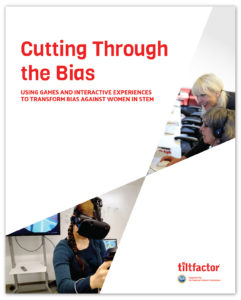 Tiltfactor develops games that explore challenging and complex social issues to understand how and when games can have impact. We design, build, and study novel games drawing on what psychologists have discovered about biases such as implicit bias, stereotype threat, prejudice, and confirmation bias in order to reduce poor decision making, limitations in education and careers, and more. One particular strand is our work on stereotype threat and implicit bias toward women in science, technology, engineering, and math (STEM). We compiled our research on these subjects into a book called Cutting Through the Bias: Using Games and Interactive Experiences to Transform Bias Against Women in Stem. You can buy a copy here download a pdf of the book here. The games that we have created as a part of this research include:
- Awkward Moment, a party card game for middle school age kids and older; preliminary findings suggest that Awkward Moment strengthens associations between women and STEM and inspires greater assertiveness in confronting social bias.
- Buffalo, a fast-paced party card game for adults and families; initial data suggests that buffalo reduces prejudice and encourages greater inclusiveness in players’ representations of social identity groups.
These games are part of the National Science Foundation-funded project, “Transforming STEM For Women and Girls: Reworking Stereotypes & Bias”, with additional assistance from the National Girls Collaborative Project.
Metadata Games
We seek to understand the ways in which games, play, and social computing can work together to solve pressing societal needs. Metadata Games (MG) is a free and open source online game system for gathering useful data for digital archives. Our aims are to create fun and engaging online experiences for players while contributing to vital archival records, and offer opportunities for cultural heritage institutions and players to connect with one another in ways they may not have otherwise. With Metadata Games, we are investigating how player motivation, game design, crowdsourcing, and natural language techniques can produce more –and higher quality– metadata for more accurate search and improve community engagement. We are working with partners at the Boston Public Library, the Massachusetts Digital Commonwealth, and the Digital Public Library of America, among others. One Up, a two-player asynchronous image tagging game for mobile devices. This is a multi-round game where you score points for submitting single-word tags and try to get more points than your opponent. One Up is designed to foster higher quality tag submissions; a more detailed explanation of the methodology and preliminary test results was published as part of the 2013 Digital Games Research Associations (DiGRA) Proceedings.
- Zen Tag, a single player game where one inputs, at their own pace, words and phrases that describe the image before them.
- Pyramid Tag, a timed single player mobile game where players try to describe an image and match as many words as possible with a group of experts.
- NexTag, a minimalized version of Zen Tag, Nex Tag offers players the ability to tag audio and moving image media.
These games are designed to be played online and also on mobile devices.
Values at Play
Values at Play investigates how designers can be more intentional about the ways in which they integrate human values into their game-based systems. Since 2005, our team has tested and created a values based, human centered designed college curriculum that is openly available on this site. We also develop novel games which integrate values and tools for other designers and learners. The project resulted in numerous papers and projects. Grow A Game design cards: Using Grow-A-Game, groups of people brainstorm novel game ideas which prioritize human values. While no prior game design experience is necessary, both experienced designers and those new to the field will have fun making games. The project also resulted in the book Values at Play in Digital Games. Cambridge: MIT Press, 2014.
Health
Our health games advance better understanding of community health issues. We investigate how design, quality, psychology, and innovation in games can result in better health communities and health outcomes. Our games aim to promote self-care, immunization and disease prevention, HIV/AIDS education, health care systems understanding, mental health, and more. We have worked with The Robert Wood Johnson Foundation, The Dartmouth Center for Health Care Delivery Science, the Minister of Health of Rwanda, and the Rippel Foundation. A sample of our games for health work includes:
- POX: SAVE THE PEOPLE, a board game and iPad app that helps players understand the concept of herd immunity through vaccination.
- Microbes, a card game developed for the Minister of Health of Rwanda to improve rates of handwashing among youth both at home and abroad.
- RePlay Health, a freely-downloadable role-playing sport that models the American health care system and allows players to change the system (developed with The Dartmouth Center for Health Care Delivery Science and the Rippel Foundation).
- In The Village, a card game that teaches self sacrificial sharing in the prevention of malaria.
- Pathways for Quality, a card game to help communities organize as part of The Robert Wood Johnson Foundation’s Aligning Forces for Quality effort.
Publications
2024
2024
Flanagan, M. and Carney, L. Speculative Game Design. In preparation.
Flanagan, M. “The Power of Gameworlds.” Sharing Desired Futures – Practices of Futurecasting. Ed. Michael Shamiyeh, De Gruyter/Birkhauser 2024.
Flanagan, Mary. “Operations & Encounters: Playing Out Performativity, “ Live Performance and Video Games: Inspirations, Appropriations and Mutual Transfers. Réjane Dreifuss, Simon Hagemann, Izabella Pluta (eds.). Theatre Studies Vol 165, Bielefeld Germany: transcript Verlag, 2024, pp. 181-192.
Flanagan, Mary. “Decolonizing Play.” Red Pepper Magazine. London: Socialist Newspaper LTD, 2024
2023
2023
Flanagan, M. “Designer Perspective.” Game Design Workshop: A Playcentric Approach to Creating Innovative Games, Fifth Edition by Tracy Fullerton. A K Peters/CRC Press.
American Journal of Play. “Games, Art and Critical Play: Interview with Mary Flanagan.” American Journal of Play 15 (2) 2023.
Flanagan, M. and Jakobbson, M. “Playing Oppression: The Legacy of Conquest and Empire in Colonialist Board Games.” Cambridge: MIT Press.
2022
2022
Flanagan, M. “Pastoral, Theo Triantafyllidis.” Worldbuilding: Gaming and Art in the Digital Age (Exhibition Catalog Essay). Julia Stoshchek Collection 15th Anniversary Exhibition, curated by Hand Ulrich Obrist. Düsseldorf: Julia Stoshchek Collection.
Flanagan, M. and Garrett, M. “Grace [Help Me Know the Truth].” Frankenstein Reanimated: Conversations with Artists in Dystopian Times. Edited by Yiannis Kolakides and Marc Garrett. London: Torque Editions, pp. 73-84.
2021
2021
Freedman G., Green M., Seidman M. and Flanagan, M. “The Effect of Embodying a Woman Scientist in Virtual Reality on Men’s Gender Biases.” Technology, Mind, and Behavior. 2(4), DOI: 10.1037/tmb0000046.
Women face pervasive biases in science, technology, engineering, and math (STEM), and games may be one avenue through which biases can be reduced. We tested whether embodying a woman scientist in virtual reality (VR) leads to more positive attitudes toward women in STEM. We also examined the effect of revealing the scientist character’s gender earlier or later in the game based on previous work indicating that a later reveal may lead to greater identification with the character. Undergraduate men (N = 96) played a physicist in a VR game in which they were randomly assigned to a man or a woman avatar whose gender they saw earlier or later in the game. Compared to participants in the man scientist condition, participants in the woman scientist condition felt more positively about women and viewed the category of woman as more overlapping with the category of scientist; however, they viewed their own scientist character more negatively. Furthermore, in both avatar conditions, participants viewed the scientist character as less competent after playing. In addition, there were no effects of the early versus late reveal on attitudes toward women scientists or toward the scientist character. Finally, there were no effects of game conditions on implicit biases, perceptions of the climate for women in STEM, stereotype endorsement, or game enjoyment. Together, this study suggests that VR interventions may decrease some negative attitudes toward women in STEM but are not a panacea for the pervasive biases against women in STEM. doi: 10.1037/tmb0000046
Kaufman, G., Flanagan, M. and Seidman, M. “Creating Stealth Game Interventions for Attitude and Behavior Change: An ‘Embedded Design’ Model.” Persuasive Gaming In Context. Eds de la Hera, T., Jansz, J., Raessens, J. and Schouten, B. Amsterdam: Amsterdam University Press, 2021, pp. 73-90.
A new book chapter by the Tiltfactor team has been published in Persuasive Gaming in Context, Amsterdam Univ Press! “Creating Stealth Game Interventions for Attitude and Behavior Change : An ‘Embedded Design’ Model” opens with examples of transformational games that utilize overt, explicit approaches to attitude and behavior change. While acknowledging the worthwhile intentions of such games and their potential utility for triggering reflection and action, this overview will present the central premise of the chapter: that there are a number of fundamental reasons why explicit approaches can backfire or be of limited utility for persuasion and that the use of more implicit, covert approaches to persuasion can be more effective. The ‘embedded design’ model presented in this chapter is particularly relevant for games attempting to engage players with sensitive or potentially threatening topics or to address attitudes or behaviors that themselves are implicit or unconscious. doi: 10.5117/9789463728805_ch05 (edited)
Flanagan, M. “If you play it, do you believe it?” Narrative Mechanics: Strategies and Meanings in Games and Real Life, Ed. Beat Suter, René Bauer, and Mela Kocher. Transcript: Bielefeld, Germany.
Flanagan, M. “Feminist(AI),” The Love Makers, by Aifric Campbell. London: Goldsmiths Press (Distributed by MIT Press).
Freedman, G., Flanagan, M., Kaufman, G., Green, M.C. (2021). Using Comics and Tweets to Raise Awareness about Gender Biases in STEM. Psychology of Popular Media.
How do social media and comics communicate about stereotypes in science? In this investigation our team approached a key gap in the current understanding of bias, science, and public discourse by examining popular media such as comics and the reception of comics and tweets about bias in science. We examined the effects of reading comics versus text stories about gender biases in STEM among college students from the United States and the UK by creating custom comics. Participants in the study either read comics or text and were asked about their views regarding women in science, their current emotions, and how likely they would be to share what they had read. Our team aimed to examine how comics versus text have the capacity to impact readers. Are comics a more effective way of increasing awareness about the biases facing women in STEM? Do comics encourage more empathy and less prejudice? doi.org/10.1037/ppm0000313.
2020
2020
Potter, S. J., Demers, J. M., Flanagan, M., Seidman, M., & Moschella, E. A. (2020, November 19). Can Video Games Help Prevent Violence? An Evaluation of Games Promoting Bystander Intervention to Combat Sexual Violence on College Campuses. Psychology of Violence, at https://dx.doi.org/10.1037/vio0000365
In the study, we replicated an assessment of two original video games designed to train students on bystander intervention skills to prevent sexual violence on college campuses. Immediate increases were found in bystander efficacy and bystander attitude scores following both game play conditions.
Flanagan, M. “Enter the Dragon,” The Infinite Playgrounds, by Bernie Dekoven with Holly Gramazio. Eds. Eric Zimmerman, Celia Pearce, and Holly Gramazio. Cambridge: MIT Press, pp. 136-139.
2019
2019
Flanagan, Mary. “A path to Our Futures.” ROMchip: A Journal of Game Histories, inaugural issue.
Freedman, G., Green, M. C., Flanagan, M., & Kaufman, G. (2019). Obituaries can popularize science and health: Stephen Hawking and interest in cosmology and amyotrophic lateral sclerosis. Psychology of Popular Media Culture. Advance online publication. doi: 10.1037/ppm0000233
Obituaries are an understudied form of popular media culture. Well-known scientists can inspire the general public to learn more about their field of study, and such exposure can occur posthumously through obituaries and related press coverage of a scientist’s passing. In the current studies, we examined the influence of physicist Stephen Hawking’s death on public interest in science topics related to his work. We also examined whether the representation of male versus female physicists quoted in the obituary increased perceptions of gender equity in science. Study 1 found that reading Hawking’s obituary increased interest in both physics and amyotrophic lateral sclerosis but that the number of female physicists quoted did not affect interest levels. Study 2 showed that following Hawking’s death, there was a marked increase in Wikipedia page views on related topics in cosmology (but not necessarily other areas of physics) and on amyotrophic lateral sclerosis. Taken together, the present research shows the influence of obituaries on public attention, as well as the outsized influence that Hawking has had on public interest in science, even in death. (PsycINFO Database Record (c) 2019 APA, all rights reserved)
Kaufman, G., Flanagan, M., & Freedman, G. (2019). Not Just for Girls: Encouraging Cross-Gender Role Play and Reducing Gender Stereotypes with a Strategy Game. CHI PLAY ’19 Proceedings of the Annual Symposium on Computer-Human Interaction in Play doi: 10.1145/3311350.3347177
Harsher socio-cultural sanctions against cross-gender role play amongst boys versus girls create comparatively greater pressure for boys to adhere to traditional gender roles [29]. At the same time, strategically orchestrated play experiences may offer a potential means of counteracting this pressure. In the present research, a pair of randomized experiments, involving a strategy game that puts players in the role of princesses, revealed a positive impact of delaying the timing of the revelation of the characters’ gender (Study 1) and reducing the degree of femininity of the illustrated representation of the characters (Study 2) on boys’ evaluations of the game, level of experience-taking (identification and role assumption) with the princess characters, and shift in both gender perceptions and self-perceptions. Together, these findings illustrate that strategic design choices can facilitate boys’ adoption of cross-gender personae and open the door to malleability in adherence to rigid gender roles and norms.
Potter, S.J., Flanagan, M., Seidman, S., Hodges, H., & Stapleton, J.G. (2018). Developing and Piloting Videogames to Increase College and University Students’ Awareness and Efficacy of the Bystander Role in Incidents of Sexual Violence. Games for Health Journal. doi: 10.1089/g4h.2017.0172
This paper describes two videogames created to teach college students bystander intervention skills in situations of sexual and relationship violence and stalking. Study results indicated that gameplay shows promise as an effective way to introduce the concept of bystander intervention and increase bystander attitudes and efficacy in situations of sexual and relationship violence and stalking to first-year college students.
Flanagan, M. “Taking Binaries off the Table.” Feminist War Games? Mechanisms of War, Feminist Values, and Interventional Games, Eds. Jon Saklofske, Alyssa Arbuckle, Jon Bath. London: Routledge, pp. 195-201.
Flanagan, M. “A Playful Planet, Despite it all,” Essay for the Playmode Exhibition Catalog, Museu de Arte, Arquitectura e Tecnologia, Lisbon, Portugal: FundaçãoEDP, pp. 124-130.
2018
2018
Freedman, G., Seidman, M., Flanagan, M., Kaufman, G., & Green, M. C. (2018). The impact of an “aha” moment on gender biases: Limited evidence for the efficacy of a game intervention that challenges gender assumptions. Journal of Experimental Social Psychology, 72, 162-167. doi: 10.1016/j.jesp.2018.03.014
One important strategy that has remained unexamined in bias interventions is the creation of an “aha” moment–the element of surprise. We decided to see whether these “aha” moments might help individuals confront the assumptions they unknowingly carry. This type of intervention is uncommon as it aims to enlighten the participant by forcing them to address internalized biases. To test our hypothesis, our team designed a mystery game, Investigation, that required players to be open-minded about the gender of scientists and health professionals. Participants in the study had to work in teams to deduce which character from a set of suspects might have stolen a biohazardous sample from a fictional university lab. They received a packet of information including a map of the building, written logs that detailed who entered and exited the rooms, and notes from the lead investigator–a fictional FBI director. We conducted two studies, the first with college students and the second with high school students, to test whether such a game could decrease explicit biases. We found that biases were well-entrenched by the time students entered college: a majority of students assumed that non-gendered scientist characters were men. This was true even though the game featured both male and female scientists. However, there’s hope–high school students were less likely to describe a female professor as a man (than participants in the control condition). Clearly, biases are stubborn and continue to pervade decision-making and problem-solving in scientific domains. In other words, the bias against women in science is still quite strong and interventions may need to begin well before students reach college.
Freedman, G., Green, M. C., Flanagan, M., Fitzgerald, K., & Kaufman, G. (2018). The effect of gender on attributions for women’s anxiety and doubt in a science narrative. Psychology of Women Quarterly. doi: 10.1177/0361684318754528
In this article, we describe a set of three studies and an internal meta-analysis that examine the impact of participant gender on how a narrative about a woman’s anxiety and doubt in a STEM setting is viewed. Across the studies, we found that men are more likely than women to attribute a woman’s negative emotions in STEM to a lack of preparation, whereas women are more likely than men to think that the woman character feels these negative emotions due to stereotype threat and awareness of biases.
Freedman, G., Seidman, M., Flanagan, M., Kaufman, G., & Green, M. C. (2018). Updating a classic: A new generation of vignette experiments involving iterative decision-making. Advances in Methods and Practices in Psychological Science. doi: 10.1177/2515245917742982
This paper provides a tutorial for researchers interested in using Twine to create interactive vignettes in their experiments. Twine is a free online tool for making interactive narratives and can be particularly useful for creating experiments in which the participants’ decisions meaningfully change the course of the experiment. We detail how to use Twine in the experimental context through three exemplar studies across the areas of psychology.
Flanagan, M. “Video Games and Gaming Culture.” Macmillan Interdisciplinary Handbooks: Gender: SPACE. Eds. Hedblad, Alan and Kooistra, Alja. New York: Macmillan, pp . 287-300.
Flanagan, M. “Critical Play and Responsible Design.” The Routledge Companion to Media Studies and Digital Humanities. Ed. Jentery Sayers. New York: Routledge, pp. 183 – 195.
2017
2017
Freedman, G., & Flanagan, M. (2017). From dictators to avatars: Furthering social and personality psychology through game methods. Social and Personality Psychology Compass, e12368. doi: 10.1111/spc3.12368.
This paper describes how different types of games can be used as measures and manipulations in social and personality psychology. Our review provides a primer for social and personality psychologists interested in using existing games or creating new games for their research as a method for understanding attitudes, behaviors, emotions, cognitions, and perceptions.
A tutorial in creating games for use in the research lab is also provided.
Green, Melanie, Fitzgerald, Kaitlin, Kaufman, Geoff and Flanagan, Mary. (2017) Self-Esteem and Public Self-Consciousness Moderate the Emotional Impact of Expressive Writing about Experiences with Bias. Personality and Individual Differences. doi: 10.1016/j.paid.2017.04.057
Games are a powerful method for social and personality psychology research: they can bring participants into meaningful, new situations and have been used for decades to understand a range of attitudes, cognitions, and behaviors. In this paper, we provide a primer for researchers interested in incorporating existing games into their research as well as advice on creating new games to bring into the laboratory.
2016
2016
Flanagan, M. and Kaufman, G. Shifting Implicit Biases With Games Using Psychology. Eds. Y. B. Kafai, G. T. Richard, & B. M. Tynes, Diversifying Barbie and Mortal Kombat: Intersectional Perspectives and Inclusive Designs in Gaming (pp.219-233). Pittsburgh, PA: Carnegie Mellon: ETC Press
Freedman, G., Williams, K. D., & Beer, J. S. (2016). “Softening the blow of social exclusion for both targets and sources: The Responsive Theory of Social Exclusion.” Frontiers in Psychology, 7 (1570).
In this article, Dr. Freedman and collaborators propose a new theory, The Responsive Theory of Social Exclusion, to provide a starting point for research on the interactive nature of social exclusion. This new theory suggests that there are three main types of social exclusion (i.e., explicit rejection, ambiguous rejection, ostracism), and that both people involved in the social exclusion will fare better if explicit rejection is used. Furthermore, this theory argues that the language of explicit rejection is an important yet understudied aspect of social exclusion, and that the linguistic choices made in a rejection can influence both parties. Dr. Freedman conducted this research before coming to Tiltfactor, and our team is delighted to think about how rejection plays into biases and other social issues.
Kaufman, G., & Flanagan, M. (2016). “High-Low Split: Divergent Cognitive Construal Levels Triggered by Digital and Non-digital Platforms.” Proceedings of the 2016 CHI Conference on Human Factors in Computing Systems, pages 2773-2777. doi: 10.1145/2858036.2858550
The present research investigated whether digital and non-digital platforms activate differing default levels of cognitive construal. Two initial randomized experiments revealed that individuals who completed the same information processing task on a digital mobile device (a tablet or laptop computer) versus a non-digital platform (a physical print-out) exhibited a lower level of construal, one prioritizing immediate, concrete details over abstract, decontextualized interpretations. This pattern emerged both in digital platform participants’ greater preference for concrete versus abstract descriptions of behaviors as well as superior performance on detail-focused items (and inferior performance on inference-focused items) on a reading comprehension assessment. A pair of final studies found that the likelihood of correctly solving a problem-solving task requiring higher-level “gist” processing was: (1) higher for participants who processed the information for task on a non-digital versus digital platform and (2) heightened for digital platform participants who had first completed an activity activating an abstract mindset, compared to (equivalent) performance levels exhibited by participants who had either completed no prior activity or completed an activity activating a concrete mindset.
Kaufman, G., & Flanagan, M. (2016). “Playing the System: Comparing the Efficacy and Impact of Digital and Non-Digital Versions of a Collaborative Strategy Game.” Proceedings of the First International Joint Conference of DiGRA and FDG, 1 (13).
The present research compared the experiences and outcomes afforded by digital and non-digital games. In a randomized experiment, a sample of youth, ages 11-17, played a cooperative public health game presented in either a non-digital format (board game) or digital format (mobile app). Relative to baseline scores reported in a no-game control condition (N = 30), players of the non-digital version of the game (N = 28) exhibited significantly higher post-game systems thinking performance and more positive valuations of vaccination, whereas players of a nearly identical digital version (N = 30) did not. This discrepancy was accounted for by key differences in play that emerged: specifically, players of the digital game exhibited a more rapid play pace and shorter turn length, and discussed strategies and consequences less frequently and with less depth. The implications for the use of games to facilitate cognitive growth and learning are discussed.
Seidman, M. J., Flanagan, M., Rose-Sandler, T., Lichtenberg, M. (2016) “Are games a viable solution to crowdsourcing improvements to faulty OCR? – The Purposeful Gaming and BHL experience.” Code4Lib Journal.
The Missouri Botanical Garden and partners from Dartmouth, Harvard, the New York Botanical Garden, and Cornell recently wrapped up a project funded by IMLS called Purposeful Gaming and BHL: engaging the public in improving and enhancing access to digital texts (http://biodivlib.wikispaces.com/Purposeful+Gaming). The goals of the project were to significantly improve access to digital texts through the applicability of purposeful gaming for the completion of data enhancement tasks needed for content found within the Biodiversity Heritage Library (BHL). This article will share our approach in terms of game design choices and the use of algorithms for verifying the quality of inputs from players as well as challenges related to transcriptions and marketing. We will conclude by giving an answer to the question of whether games are a successful tool for analyzing and improving digital outputs from OCR and whether we recommend their uptake by libraries and other cultural heritage institutions.
Kaufman, G., Flanagan M., & Punjasthitkul, S. (2016). “Investigating the Impact of ‘Emphasis Frames’ and Social Loafing on Player Motivation and Performance in a Crowdsourcing Game.” Proceedings of the 2016 CHI Conference on Human Factors in Computing Systems, May 07-12, 2016, Santa Clara, California, USA. doi: 10.1145/2858036.2858588.
Flanagan, M. “An Alternate History of Wargaming.” Zones of Control: Perspectives on Wargaming. Eds. Pat Harrigan and Matthew Kirschenbaum. Cambridge: MIT Press, pp. 703-707.
Flanagan, M. “Games as a Medium.” Debugging Game History: A Critical Lexicon. Eds. Raiford Guins and Henry Lowood. Cambridge: MIT Press, pp. 221-228.
Flanagan, M. “Game Art.” Debugging Game History: A Critical Lexicon. Eds. Raiford Guins and Henry Lowood. Cambridge: MIT Press, pp. 151-158.
Flanagan, M. “Critical Play: The Productive Paradox.” Blackwell Companion to Digital Art, ed. Christiane Paul, New York: Wiley Blackwell, pp. 445-460.
2015
2015
Kaufman, G., & Flanagan, M. (2015). “A psychologically “embedded” approach to designing games for prosocial causes.” Cyberpsychology: Journal of Psychosocial Research on Cyberspace, 9(3), article 1. doi: 10.5817/CP2015-3-5
Prosocial games often utilize a direct, explicit approach to engage players with serious real-life scenarios and present information about key societal issues, but this approach may limit a game’s persuasive impact–particularly when the apparent aims of the game trigger players’ psychological defenses or reduce players’ potential engagement. In contrast, the “Embedded Design” approach that we introduce here offers effective, evidence-based strategies for delivering persuasive content. This paper provides an in-depth exploration of two key Embedded Design strategies: (1) intermixing: combining “on-topic” and “off-topic” game content in order to make the focal message or theme less obvious and more accessible and (2) obfuscating: using game genres or framing devices that direct players’ attention or expectations away from the game’s true aims. To illustrate the implementation and effectiveness of these strategies, we detail the design of two games that utilize a number of these techniques.
Kaufman, G., Flanagan, M., and Seidman, M. “Creating Stealth Game Interventions for Attitude and Behavior Change: An ‘Embedded Design’ Model.” Proceedings of the Digital Games Research Association (DiGRA) 2015.
Persuasive games tackling serious issues in a literal, explicit fashion are far less likely to succeed in changing attitudes or behaviors than are games that take the more “stealthy” approach of embedding persuasive messages within a game’s content or context. The “Embedded Design” model, which we introduce here, offers novel, evidence-based strategies for including persuasive content in a game in a fashion that circumvents players’ psychological defenses, triggers a more receptive mindset for internalizing a game’s intended message, and does so without sacrificing players’ enjoyment or the game’s replayability. Such techniques promise to revolutionize the ways that game developers tackle serious issues in games. Three original “embedding” strategies are presented: (1) Intermixing: balancing “on-message” and “off-message” content to render the former less overt or threatening; (2) Obfuscating: using framing devices or genres that divert expectations or focus away from the game’s persuasive intent; and (3) Distancing: employing fiction and metaphor to increase the psychological gap between players’ identities and beliefs and the game’s characters and persuasive content.
Seidman, M., Flanagan, M., and Kaufman, G. “Failed Games: Lessons Learned from Promising but Problematic Game Prototypes in Designing for Diversity.” Proceedings of the Digital Games Research Association (DiGRA) 2015.
Iterative game design approaches have proven effective in creating persuasive games, but these approaches inevitably lead to as many abandoned designs as ones that are pursued to completion. This paper serves as a reflective and instructive post mortem for the unpublished non-digital game prototypes developed for our team’s “Transforming STEM for Women and Girls: Reworking Stereotypes & Bias” (BIAS) research project. We outline three abandoned designs and explain why they were ultimately not pursued, focusing on the challenges of balancing enjoyability, feasibility of production, and impact. We discuss design strategies, including: masking games’ persuasive intentions, prioritizing prototypes with their efficacy-to-cost ratio in mind, and designing for fun first. This discussion offers insights into the design of both non-digital and digital “games for impact” that allow designers and researchers alike to learn from these promising but problematic prototypes.
Kaufman Geoff, Flanagan Mary, Seidman Max, and Wien Simone. “‘RePlay Health’: An Experiential Role-Playing Sport for Modeling Healthcare Decisions, Policies, and Outcomes.” Games for Health Journal, 4(4), 2015. doi: 10.1089/g4h.2014.0134.
This article presents the empirical investigation of a novel role-playing sport, the “RePlay Health” game (www.replayhealth.com/), which was inspired by computer simulation of healthcare dynamics. The game immerses players in a fictional world in which they take on the role of characters who are prone to behavioral and environmental risk factors. In a randomized experiment testing the efficacy of the game, active players (as compared with spectators) reported significantly higher scores in subjective ranking of several health policies modeled by the game. After gameplay, players were also significantly more likely to understand health systemically by identifying environmental and systemic factors in health problems.
Manzo, C., Kaufman, G., Punjasthitkul, S., & Flanagan, M. “‘By the People, For the People’: Assessing the Value of Crowdsourced, User-Generated Metadata.” Digital Humanities Quarterly, 9(1), 2015.
With the growing volume of user-generated classification systems arising from media tagging-based platforms (such as Flickr and Tumblr) and the advent of new crowdsourcing platforms for cultural heritage collections, determining the value and usability of crowdsourced, “folksonomic,” or user-generated, “freely chosen keywords” for libraries, museums and other cultural heritage organizations becomes increasingly essential. The present study builds on prior work investigating the value and accuracy of folksonomies by: (1) demonstrating the benefit of user-generated “tags” – or unregulated keywords typically meant for personal organizational purposes – for facilitating item retrieval and (2) assessing the accuracy of descriptive metadata generated via a game-based crowdsourcing application. In this study, participants (N = 16) were first tasked with finding a set of five images using a search index containing either a combination of folksonomic and controlled vocabulary metadata or only controlled vocabulary metadata. Data analysis revealed that participants in the folksonomic and controlled vocabulary search condition were, on average, six times faster to search for each image (M = 25.08 secs) compared to participants searching with access only to controlled vocabulary metadata (M = 154.1 secs), and successfully retrieved significantly more items overall. Following this search task, all participants were asked to provide descriptive metadata for nine digital objects by playing three separate single-player tagging games. Analysis showed that 88% of participant-provided tags were judged to be accurate, and that both tagging patterns and accuracy levels did not significantly differ between groups of professional librarians and participants outside of the Library Science field. These findings illustrate the value of folksonomies for enhancing item “findability,” or the ease with which a patron can access materials, and the ability of librarians and general users alike to contribute valid, meaningful metadata. This could significantly impact the way libraries and other cultural heritage organizations conceptualize the tasks of searching and classification.
2014
2014
Kaufman, G., Flanagan, M., and Punjasthitkul, S. “Exploring the impact of ‘emphasis frames’ on player motivation and performance in a crowdsourcing game.” In Proceedings of the 2014 Meaningful Play Conference.
Relatively little empirical work has systematically verified the claims regarding crowdsourcing games as more ‘fun or productive’ than other crowdsourcing interfaces, and fewer still have identified the psychological factors that might impact the motivation to play crowdsourcing games to encourage better data. Study 1 (N = 97) compared the number of individual tags contributed by players who were shown, prior to play, one of three game “frames” emphasizing distinct motivators identified by prior research. Study 2 (N = 148) tested this hypothesis by comparing the social norm frame used in Study 1 with two new frames that combined the language of the original frame. The findings demonstrate the powerful impact of emphasizing distinct motivational factors when presenting a game to players, and illustrate the potentially detrimental impact of highlighting descriptive norms for participation in crowdsourcing. The research suggests that one effective means of counteracting social loafing in crowdsourcing is to make salient the value of users’ contributions or by stressing the value of users’ unique perspectives for contributing.
Flanagan, M., and Nissenbaum, H. (2014). “Values at Play in Digital Games.” Boston: MIT Press.
All games express and embody human values, providing a compelling arena in which we play out beliefs and ideas. “Big ideas” such as justice, equity, honesty, and cooperation—as well as other kinds of ideas, including violence, exploitation, and greed—may emerge in games whether designers intend them or not. In this book, Mary Flanagan and Helen Nissenbaum present Values at Play, a theoretical and practical framework for identifying socially recognized moral and political values in digital games. Values at Play can also serve as a guide to designers who seek to implement values in the conception and design of their games.After developing a theoretical foundation for their proposal, Flanagan and Nissenbaum provide detailed examinations of selected games, demonstrating the many ways in which values are embedded in them. They introduce the Values at Play heuristic, a systematic approach for incorporating values into the game design process. Interspersed among the book’s chapters are texts by designers who have put Values at Play into practice by accepting values as a design constraint like any other, offering a real-world perspective on the design challenges involved.
Flanagan, M. “Playful Aesthetics: Toward a Ludic Language.” Gameful World, Ed. S. Walz and Sebastian Deterding. Cambridge: MIT Press, pp. 249-271.
2013
2013
Kaufman, Geoff and Flanagan, M. “Lost in Translation: Comparing the Impact of an Analog and Digital Version of a Public Health Game on Players’ Perceptions, Attitudes, and Cognitions.” International Journal of Games and Computer Mediated Simulations, 5(3) 2013, 1-9.
As growing body of work demonstrates the ability of games to significantly transform cognitive skill sets and attitudes toward social issues, including public health, it becomes increasingly imperative to understand the divergent outcomes afforded by analog and digital game platforms. Here, authors learn that a nearly identical, digital version of an analog public health game has shown to be less effective at facilitating learning and attitude change. Several explanations based on psychological theories are discussed.
Flanagan, M., Punjasthitkul, S., Seidman, M., Kaufman, G. and Carini, P. “Citizen Archivists at Play: Game Design for Gathering Metadata for Cultural Heritage Institutions.” Proceedings of DiGRA 2013, Atlanta, Georgia, August 2013.
This overview of the Metadata Games project explains the potential role of games in collecting valuable information about archival media through crowdsourcing. Challenges are discussed, including maximizing the player audience, ensuring high replayability, and verifying the accuracy of publicly generated data. The authors ultimately present the “Outlier Design” model used to identify and address these challenges.
Flanagan, M. “The Bride Stripped Bare.” Reprinted in: Feminist and Queer Information Studies Reader, Eds. by Patrick Keilty and Rebecca Dean. Sacramento, CA: Litwin Books.
2012
2012
Flanagan, M. & Carini, P. (2012). “How games can help us access and understand cultural artifacts.” American Archivist, 75(2), pp 514-537.
As libraries and archives seek to digitize millions of items, institutions struggle to collect quality, relevant metadata–the informative tags regarding an item’s content, context, and creation. Reporting on a pilot study of Metadata Games, this paper elaborates on the utility games in collecting metadata, and the potential connection fostered between such rich archival data and a diverse user base which includes researchers, hobbyists, and of course, gamers!
Kaufman, G. and Libby, L. Changing Beliefs and Behavior Through Experience-Taking Journal of Personality and Social Psychology, March 26, 2012.
The present research introduces the concept of experience-taking, in which individuals’ spontaneously orient themselves around the identity of a character within a narrative, simulating the emotions, behaviors, goals, and traits of the character as if they were one’s own.The six studies detailed here investigated the conditions under which this imaginative process occurs while reading a brief fictional work, with special attention to self-concept accessibility, first vs. third-person narrative voice, and ingroup-outgroup membership. Implications for behavior are discussed.
2011
2011
Flanagan, M., Seidman, M., Belman, J., Punjasthitkul, S., Downs, Z., Ayoob, M., Driscoll, A., and Downs, M. Preventing a POX Among the People? A Design Case Study of a Public Health Game Proceedings of DiGRA 2011 Conference: Think Design Play, Hilversum, Netherlands.
POX: SAVE THE PEOPLE is a board game challenging players to stop the spread of a deadly disease. This article details the design process of a public health game, seeking to understand the ways in which science knowledge can be embedded in the game, and transferred from a board to its players.
Belman, J., Nissenbaum, H., Flanagan, M., and Diamond, J. Grow-A-Game: A Tool for Values Conscious Design and Analysis of Digital Games Proceedings of DiGRA 2011 Conference: Think Design Play, Hilversum, Netherlands.
Developed by the Values at Play (VAP) project, the Grow-A-Game cards facilitate values-conscious design and analysis of digital games. In this report, we follow the Grow-A-Game cards as they are implemented in a series of beginner and advanced game design courses, where they are used to better understand the relationship between values and games, as well as to produce innovating and interesting values-focused designs.
Flanagan, M. “Play, Participation, and Art: Blurring the Edges.” Context Providers. Eds. Margot Lovejoy, Christiane Paul, Victoria Vesna. Chicago: U. of Chicago Press (Intellect Press).
2010
2010
Belman, J. and Flanagan, M. Exploring the Creative Potential of Values Conscious Design: Students’ Experiences with the VAP Curriculum. Eludamos: Journal for Computer Game Culture
The goals of Values at Play (VAP) is to investigate the role of social, moral, and political values in digital games, and to develop a systematic apporach to integrating human values in the design process. Authors provide an overview of the curricula and materials created to date, disucssing their use in graduate and undergraduate game design courses.
Belman, J. and Flanagan, M. Designing Games to Foster Empathy. Cognitive Technology, 14(2).
Research converges on the idea that games are well-suited for fostering empathy in players and groups. The authors begin with an overview of psychology research on empathy, followed by a set of heuristic principles derived from the literature which have direct and practical applications for the design of games for the social good. Lastly, the authors visit three games–PeaceMaker, Hush, and Layoff–as examples of games which have incorporated these approaches into their design.
Flanagan, M. “Creating Critical Play” Artists Re:Thinking Games. Eds. Ruth Catlow, Marc Garrett, and Corrado Morgana. Liverpool: Liverpool University Press, pp. 49-53.
2009
2009
Flanagan, M. Critical Play. Cambridge: MIT Press.
Flanagan, M. . “Locating Play and Politics: Real World Games & Activism.” Leonardo Electronic Almanac Special Issue from perthDAC: Social Media: Narrative and Literacy in Digital Culture.
Belman, J., Flanagan M., and Nissenbaum, H. Instructional Methods and Curricula for Values Conscious Design. Loading: The Official Journal of the Canadian Games Studies Association, 3(4).
Values at Play seeks to investigate the role of social, moral, and political values in digital games. Goals of this project include developing approaches to considering values in the design process, as well as creating and disseminating curricula and instructional materials for introducing students to “values conscious” design. Here, authors provide an overview of curricula and instructional materials as implemented in graduate and undergraduate game design courses.
Flanagan, M. and Lotko, A. Anxiety, Openness, and Activist Games: A Case Study for Critical Play. Proceedings of the Digital Games Research Association, Uxbridge UK, 2009.
A case study of a popular activist game demonstrates how the most powerful play experience results from a new relationship formed between the audience and the player, with special attention to the game’s mechanics, subject position, representation, and content.
Flanagan, M. “An Appreciation on the Impact of the work of Sonia Landy Sheridan.” In The Art of Sonia Landy Sheridan, by Diane Kirkpatrick, Mary Flanagan, Sonia Landy Sheridan. Hanover, NH: Hood Museum of Art, 37-42.
2008
2008
Flanagan, M. and Nissenbaum, H. Design Heuristics for Activist Games. Beyond Barbie to Mortal Kombat. C. Heeter and Y. Kafai (eds). Cambridge: MIT Press 2008.
Games have come to be integral to human culture. Given contemporary understanding that human principles could be embedded in game design, the authors offer a values-conscious approach to design, opening opportunities for socially conscious gameplay and design.
Flanagan, M., Howe, D., and Nissenbaum, H. Values in Design: Theory and Practice.” (pdf) In Information Technology and Moral Philosophy, Jeroen van den Hoven and John Weckert (eds.) Cambridge: Cambridge University Press, 2008.
In a spectrum of approaches to the study of technology and society, it has been understood that values come to be embodied in technical systems and devices. The authors of this paper offer a more holistic approach to design, in which values are equally as relevant to design as functionality. As a more general goal, the authors hope to foster a world where our technology reflects our social, political, and moral values.
Flanagan, M. and Nissenbaum, H. “Design Heuristics for Activist Games.” In Beyond Barbie to Mortal Kombat: New Perspectives on Gender and Computer Games. Y.B. Kafai, J. Denner, C. Heeter, and J. Sun (eds). Cambridge: MIT Press, pp. 265-279.
Flanagan, M., Howe, D. and Nissenbaum, H. “Embodying Values in Technology: Theory and Practice” In Information Technology and Moral Philosophy. Eds. Jeroen van den Hoven and John Weckert. Cambridge: Cambridge University Press, pp. 322-353.
2007
2007
Flanagan, M. and Booth, A, Eds. re: skin. Cambridge: MIT Press.
Flanagan, M. “reskinning the everyday.” re: skin. Cambridge: MIT Press, pp. 303-319.
Flanagan, M. The Sims: Suburban Utopias Borries, Friedrich von, Walz, Steffen P., Böttger, Matthias (eds.) Space Time Play. Synergies Between Computer Games, Architecture and Urbanism, Birkhäuser Publishing, Basel Boston Berlin, 2007. Plass, J. L, Goldman, R., Flanagan, M., Diamond, J., Dong, C., Looui, S., Hyuksoon Song, H., Rosalia, C., and Perlin, K. RAPUNSEL: How a computer game designed based on educational theory can improve girls’ self-efficacy and self-esteem. Proceedings of the American Educational Research Association, Chicago, April 2007.
The authors review a three-year project to design a web-based software environment for real-time, applied programming for underrepresented students’ early literacy (RAPUNSEL), the chief goal of which, was to design an interactive way to teach middle school girls computer programming. Accomplished through the computer game environment called Peeps, students used programming as a means to achieve goals relevant to other players. By facilitating safe ways to learn-by-error, students’ experienced increases in self-efficacy, self-esteem, computer self-efficacy, and programming self-efficacy. Implications for educators and designers are discussed.
Flanagan, M. Locating Play and Politics: Real World Games and Political Action. Proceedings of the Digital Arts and Culture Conference, Perth Australia, Dec 2007.
The author explores the potential of locative media to act as a tool for empowerment, community building, and cultural change, by offering a conception of the urban environment as a site of novel play experiences. New technologies and mobile platforms contribute to the city’s playscape, and further inform the ways in which creative projects will continue to engage the city itself as the environment for play. Implications for this form of play are discussed, and the social and political possibilities of taking play to the streets are explored.
Flanagan, M., Nissenbaum, H., Diamond, J., and Belman, J. A Method for Discovering Values in Digital Games. Full paper presented at Situated Play DiGRA ’07 (Tokyo, JP September 24-28, 2007).
The authors present a tool called “Values Cards,” which when used as part of the game-design process, prompt creators to consider how values are expressed through game mechanics and representational elements. Analyses of such concepts can be posted to a collective wiki and shared among designers interested in games from a values perspective.
Flanagan, M. and Nissenbaum, H. A Game Design Methodology to Incorporate Activist Themes. Proceedings of the CHI 2007 conference, 28 April – May 3, San Jose, California. Flanagan, M. and Nissenbaum, H. A Game Design Methodology to Incorporate Social Activist Themes. Proceedings of CHI 2007. New York, NY: ACM Press, 181 – 190.
The authors explore a variety of educational and activist game approaches, specifically projects involving design for young women. Offering a close look at Values at Play (VAP), the authors show how a values-based methodology that could be implemented in the creation of games as well as the teaching of game design.
Flanagan, M., Howe, D, and Nissenbaum, H. “New Design Methods for Activist Gaming.” Worlds In Play: Intnl Perspectives on Digital Games Research, Eds. S. deCastell, J. Jensen. NY: Peter Lang, pp. 241-48.
Flanagan, M. and Looui, S. Rethinking the F Word: A Review of Activist Art on the Internet. National Women’s Studies Association Journal (Special Issue: Feminist Activist Art) 19:1, Spring 2007, 181-200.
New technologies have a variety of potential applications for feminist activism. Here, the authors explore emerging directions of feminist art in relation to the internet, considering how technology has informed and realized the goals of feminist artists and activists. Challenges and possibilities of new media, feminist art are discussed.
Feminist Art Activist Roundtable. National Women’s Studies Association Journal (Special Issue: Feminist Activist Art). 19:1, Spring 2007.
This special issue presents a roundtable with contemporary feminist, activist, designers and artists. Creators discuss trends toward tactical intervention for the social good, and implications for art and design in altering the social and cultural landscape.
2006
2006
Flanagan, M. My Profile, Myself in Playculture. Exploring Digital Artefacts . Johan Bornebusch and Patrik Hernwall, Editors. M3 Publication, 2006, 20-29.
Flanagan, M.Making Games for Social Change. AI & Society: The Journal of Human-Centered Systems. Springer London: Springer, 20:1, January 2006.
Flanagan, M. “Politicising Playculture.” GAME/PLAY Exhibition Catalog. HTTP Gallery, London.
Flanagan, M. The ‘Nature’ of Networks: Space and Place in the Silicon Forest. Nature et progrès : interactions, exclusions, mutations. Ed. Pierre Lagayette. Paris : Presses de l’Université. Paris-Sorbonne, 2006.[/vc_column_text]
2005
2005
Flanagan, M., Howe, D. C., and Nissenbaum, H. New Design Methods for Activist Gaming. Proceedings from DiGRA 2005, 16-20 June, Vancouver, BC, Canada.
Designers and engineers are becoming increasingly aware of the ways in which political, social and ethical values come to be embodied in the artifacts they create. Here, the authors introduce systematic methods for the discovery, analysis, and integration of values into the work of game designers and technologists, discussing the benefits and challenges of a values-oriented approach as it applies to a variety of design contexts.
Flanagan, M. Troubling ‘Games for Girls’: Notes from the Edge of Game Design. Proceedings from DiGRA 2005, 16-20 June, Vancouver, BC, Canada.
The author presents notes from a project to design an activist, multiplayer game for middle-school girls, providing diverse feedback on RAPUNSEL. This paper challenges the many gender-based stereotypes that are inherent in computing culture, and further discusses how a designer may allow for multiple play styles.
Flanagan, M., Howe, D.C., and Nissenbaum, H. Values at Play: Design Tradeoffs in Socially-Oriented Game Design. Proceedings of the CHI 2005 conference on Human factors in computing systems. CHI 2005, 2-7 April, Portland, Oregon. New York: ACM Press.
As designers and engineers come to understand the ways in which political, social and cultural values come to be embedded in games, many struggle to find balance between their own values and those of users, stakeholders, and those of the surrounding culture. Authors present the RAPUNSEL project as a case study of game design in a values-rich context, and describe efforts navigating among value sets.
2004
2004
Flanagan, M. Developing Virtual Performance Spaces. American Puppetry. Ed. Phyllis T. Dircks. New York: Theatre Library Association, 2004.
2003
2003
Flanagan, M. and Bittanti, M. Similitudini. Simboli. Simulacri (SIMilarities, Symbols, Simulacra). Ludologica 3. Milano: UNICOPLI.
Flanagan, M. “SIM-plement l’espace du genre? Vies domestiques, consommation et le Sims.” (SIMply Gendered Space? Domesticity, Consumption & The Sims) Consommations & Sociétés: Cahiers pluridisciplinaire sur la consommation et l’interculturel. Ed. M. Roustan et D. Desjeux.
Flanagan, Mary. “Flanagan, Mary. “gender + play: domestic space + consumption.” Intelligent Agent 43(1).
Flanagan, M. Une Maison de Poupee Virtuelle Capitaliste? The Sims: Domesticite, Consommation, et Feminite. Consommations & Sociétés: Cahiers pluridisciplinaire sur la consommation et l’interculturel. Ed. Mélanie Roustan et Dominique Desjeux. Flanagan, M. the bride stripped bare to her Data: information flow and digibodies. in Data Made Flesh, Thurtle et al.
The author offers an overview of digital information representation, focusing on the embodied code of virtual characters. The world’s first virutal newscaster, Ananova, a character-based, live-information interface, Motorola’s Mya data service, and Syndi, a “celebrity portal” search engine that purports a subjective experience through a character are followed as exemplars. The author discusses the role of the female in these representations, as well as the ramifications of data embodiment, particularly as it pertains to information conveyed through female-shaped bodies.
Flanagan, M. Next Level: Women’s Digital Activism through Gaming. Digital Media Revisited. Edited by Andrew Morrison, Gunnar Liestøl & Terje Rasmussen. Cambridge: MIT Press, 2003, 359 – 388.
The author explores noncommercial computer games created by women in order to explore the ways in which language and conventions of gaming culture are shaped and reshaped by women artist activists. Focusing on the works of Natalie Bookchin, Pamela Jennings, and Lucia Grossberger-Morales, the author discusses motivations, themes, and impacts of feminist gaming practices in culture and cyberfeminism.
Flanagan, M. “The Bride Stripped Bare.” Data Made Flesh: Embodying Information. Eds. P. Thurtle and R. Mitchell, New York: Routledge.
Flanagan, M. Response to Celia Pearce: About Computer Gaming. First Person. Ed. Noah Wardrip-Fruin and Pat Harrigan. Cambridge: MIT Press, pp. 143-145.
2002
2002
Flanagan, M. Hyperbodies, Hyperknowledge: Women in Games, Women in Cyberpunk, and Strategies of Resistance. reload: rethinking women + cyberculture. Cambridge: MIT Press, 2002, 425-454.
While there are more female protagonists in popular computer games than in cinema, they are prone to rigid styles of representation based largely on men’s fantasies. Here, the author presents digital art projects that challenge assumptions about the body and knowledge, gender, and technology, in an effort to articulate the formation and workings of knowledge for women within technoculture.
2001
2001
Spatialized MagnoMemories. Culture Machine 3 – Virologies: Culture and Contamination. Eds. David Boothroyd and Gary Hall. 2001.
2000
2000
Flanagan, M. navigable narratives: gender +narrative spatiality in virtual worlds. Art Journal. 59:3, Fall 2000, 74 – 85.
Technology affords space for unique means of storytelling and identity formation. This paper seeks to understand the construction of virtual bodies and space by examining the ways in which concepts of gender are embedded in the construction of online worlds. The author discusses the implications of performing the digital space, with regard to the political specificity of virtual reality.
1999
1999
Flanagan, M. Mobile Identities, Digital Stars, & Post-Cinematic Selves. Wide Angle: Issue on Digitality & the Memory of Cinema. 21:3, 1999.
The author discusses the emergence of female, digital stars as they relate to those of contemporary film. Presenting comparison between digital stars and stars of film history, the author complicates the “man-made” female form, as well as highlights the subject/object positions examined by feminist scholars of popular media.
Flanagan, M. Digital Stars Are Here to Stay. convergence: the journal of research into new media technologies. Eds. Julia Knight + Alexis Weedon, University of Luton.
The author makes the case for digital stars of gaming by showing how such characters engage each individuals’ unique sense of agency, and how players engage intimate relationships with the avatars they control.
Flanagan, M. and Egert, C. “Courseware Quality + the Collaborative Classroom: Implementing IOS Courseware to Generate Seminar-style Interactions.” IMEJ, The Interactive Multimedia Electronic Jrnl of Computer-Enhanced Learning.
Flanagan, M. Mobile Identities, Digital Stars, & Post-Cinematic Selves. Wide Angle: Issue on Digitality & the Memory of Cinema. 21:3, 1999.